These records are found in the online catalog of The Mariners’ Museum and Park in Newport News, Virginia. Uncurated search results are presented to give researchers and interested readers an idea of whether the museum’s archives contain information about this vessel and whether it may be worthwhile to visit the museum’s catalog search page for further investigation. Uncurated results may be inaccurate or incomplete.
Mariners Museum online catalog search, July 12, 2026. Search phrase: "Father and Son". Catalog returned 15 records; this selection table includes 15 records fetched through catalog result pages.
Use these buttons to send uncurated search results to your own app or text document for further research. First, check the box for any row, or click "Select All" then uncheck any rows. Then click "Show Selections". You can then copy your selections from the text box and past them into your app.
REUNION OF FATHER AND SON - Col. William R. Galbreath, 0156137, commanding officer of the Camp Patrick Henry station hospital, (left above) and his son, T/4 John W. Galbreath, 33464878, just after the latter arrived at camp on July 2nd after debarking from the Cristobal. Overseas since December 15, 1944, young Galbreath was with the 120th evacuation field hospital unit.
Shows a father, who is an officer, with his son, an enlisted man, returned from overseas.
Photo shows Capt. Daniel Rosenfelt, NAB Medical Officer, and his son, Ronald Rosenfelt eating ice cream and cake at Kiddie's Party given for children on enlisted men and officers of NAB at base Service Club, Norfolk Army Base, HRPE, Norfolk, Va.
Children of military personnel–Virginia–Norfolk.; Christmas decorations–Virginia–Norfolk.; Christmas trees–Virginia–Norfolk.
Shows a father and son seated at a table, the son is smiling while he eats cake. There is a Christmas tree in the background.
Col. H.D. Riley saying goodbye to his son as he is about to depart from HRPE Newport News, Va. for service overseas.
Embarkation (Military science).; Children of military personnel–Virginia–Newport News.
Shows a father and son saying shaking hands on an HRPE pier. The son is partially up a gangplank while his father is standing on the pier. Another ship can be seen in the background.
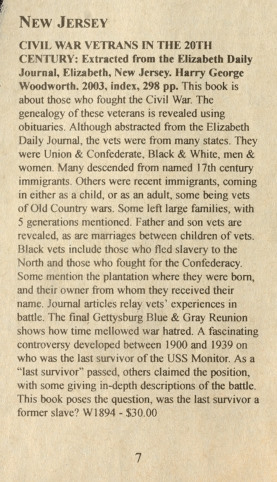
Clipping of a one page article. Discusses a book with genealogical information about Union, Confederate, black, white, men, and women participants in the Civil War. Also states that with the use of obituaries, it reveals father and son veterans, marriages between children of veterans, and black veterans who fled slavery to the North. Lastly, it discusses the controversy on who can rightfully claim that they were the last survivor of the Monitor.
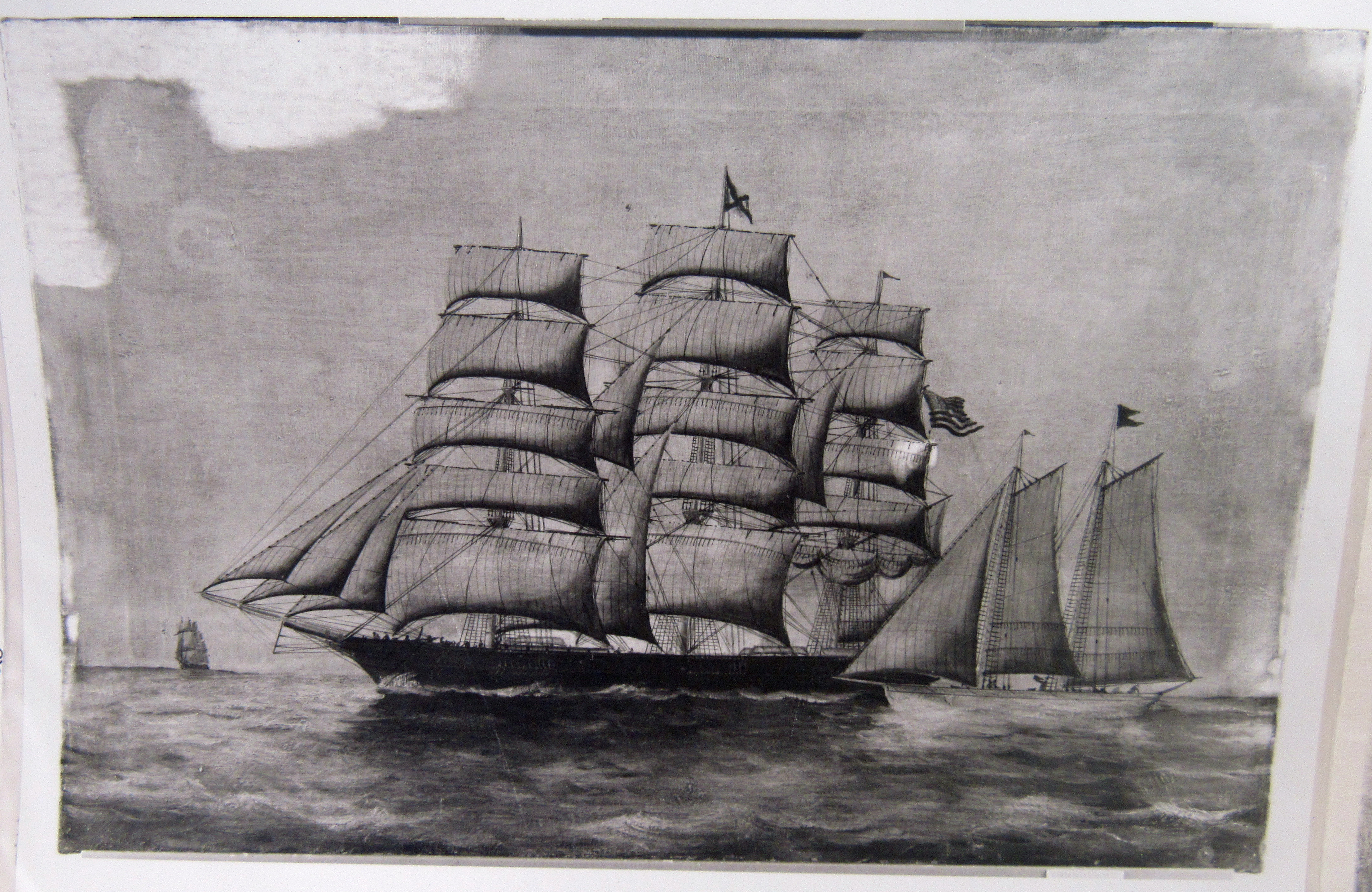
NOTES: Joseph B. Smith and William B. Smith were a father and son partnership, marine artists working primarily in Brooklyn in the 1850s, 60s, and 70s. Though they were listed in directories of the day and were exhibited in the 19th century, their work is extremely scarce today. Little is known with certainty about the two except that they were commissioned by Currier & Ives to do the paintings for several oft he publisher's shipping prints. The 'Ocean Express' is a preliminary version of the composition which was used by Currier and Ives for "Clipper Ship 'Ocean Express' outward bound, Discharging her pilot" published in 1856 and one of their most popular shipping prints. The 'Ocean Express' was a vessel built by J. O. Curtis of Meford, Massachusetts and advertised by her builder as "First in speed, first in beauty and first in the world of waters". The 'Ocean Express' is a well-known vessel, flying an American flag.
Steamboat lines.; Steamboats–Chesapeake Bay (Md. and Va.).; Marine engineering–Examinations, questions, etc.; World War, 1939-1945–Campaigns–Atlantic Ocean.; Shipwreck victims–Atlantic Coast (U.S.).; Tankers–History. United States; Merchant mariners–Death.
This small collection contains materials created or collected by a father and son who both worked shipboard. The elder Lawson's papers reflect his work as an engineer, mostly on ships from the Norfolk and Washington Steamboat Co. The ephemera includes a menu, clippings, postcards, stationery, tickets, etc. Included are questions and answers to test questions that Lawson Senior wrote out on disused log book pages from the ferry that provided service across Chesapeake Bay between Baltimore and Claiborne, MD, for the Baltimore, Chesapeake and Atlantic Railroad. Materials from Lawson Junior include a photograph and a scrapbook of the tanker Francis E. Powell, on which he served and which was torpedoed and sunk about 8 1/2 miles off Assateague Island on January 27, 1942. Four crewmen were lost, including Captain T. J. Harrington.
Great Britain–History, Naval–Tudors, 1485-1603–Congresses.; Great Britain–Court and courtiers–History–16th century–Congresses; Great Britain–History–Elizabeth, 1558-1603–Congresses.; Roanoke Colony–Congresses
Explorers–England and Wales–Biography–Congresses.; Privateering–History–England–Congresses
Great Lakes Region (North America).; Great Lakes (North America)–Navigation–History.
Steamboats–Great Lakes (North America).; Ferries–Great Lakes (North America).; Tugboats–Great Lakes (North America).; Whalebacks.; Tankers.
Collection of photographs of Great Lakes vessels (steamers, tugboats, ore carriers, passenger vessels, ferry boats and pleasure craft). These photographs were taken by John T. Reeder or by his son John H. in the period from 1880 to 1960. They were taken in and around the Lake Superior area. Information provided by the donor indicates that the photographs are contact prints from the original negatives, now presumed lost. The 5x7 contact prints are from glass plate negatives and indicate the older photographs. The remaining are printed from large format film negatives.
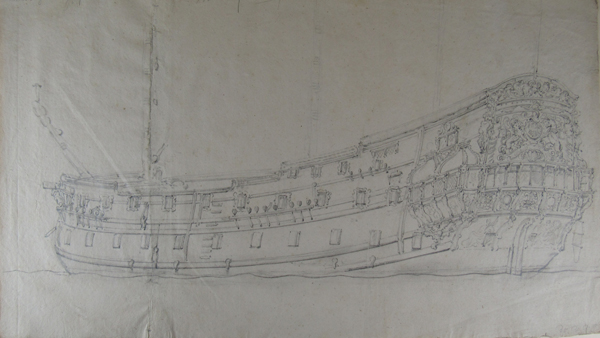
SHORT DESCRIPTION: Crayon sketch showing the Royal Navy warship HBMS Montagu from the port quarter. Pencil inscription in the upper left corner. Watermark of a horn on shield around the stern of the drawing (see drawing 2 on page 205 and page 211 of 'Van de Velde Drawings, A Catalogue of Drawings in the National Maritime Museum..."). TRANSLATION: Montagu this ship was built 1675,...1673 NOTES: On page 273 of 'Van de Velde Drawings, A Catalogue of Drawings in the National Maritime Museum..." there is a similar image of the Montagu. The image at NMM seems to have been highlighted with wash. VESSEL HISTORY: HMS Lyme was a 52-gun third rate Speaker-class frigate built for the navy of the Commonwealth of England at Portsmouth, and launched in 1654. After the Restoration in 1660 she was renamed HMS Montagu. She was widened in 1675. In 1677 HMS Montagu was one of the vessels that escorted William of Orange and Princess Mary to Holland. She underwent her first rebuild in 1698 at Woolwich Dockyard as a 60-gun fourth rate ship of the line. Her second rebuild took place at Portsmouth Dockyard, from where she was relaunched on 26 July 1716 as a 60-gun fourth rate to the 1706 Establishment. The Montagu was broken up in 1749.
NEW HAVEN - CONNECTICUT - UNITED STATES - Manufacturer
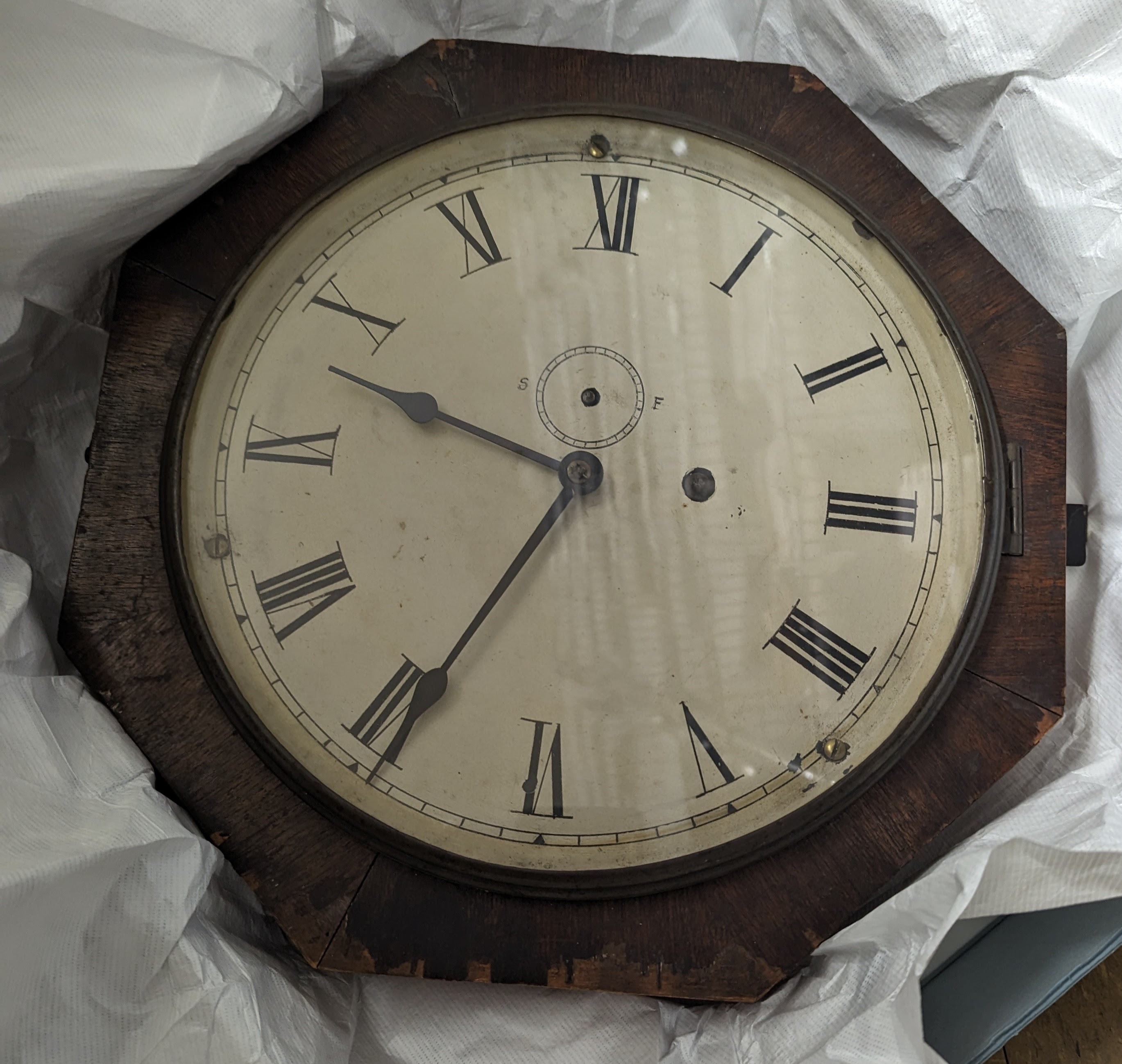
SHORT DESCRIPTION: Round marine clock in octagonal wooden case (veneer over pine?) with a hinged glazed bezel and a screw-retained solid back. White painted metal dial with black Roman numerals I-XII within a minute circle. Blued-steel hour and minute hands. Spring-driven, eight-day or 30-hour movement with Charles Kirk's patent escapement. Slow-fast adjustment on dial face. Made by the Marine Clock Manufacturing Company of New Haven, Connecticut. With label on reverse and brass key. Reportedly used aboard the steamer Monohanssett. NOTES: Charles Kirk of Bristol Connecticut was granted US Patent No. 5045 on April 3, 1847 for his dual escape wheel clock movement for which he claimed better time keeping because "external motion does not interrupt the time...and not as liable to be deranged." The Marine Clock Manufacturing Co. of Hamden and New Haven, Connecticut was founded by Charles Kirk (the clockmaker), Eli Whitney, Jr., and father and son Eli (farmer) and Elias Dickerman. In Hamden 1847-1853. NOTES: The New Bedford, Martha’s Vineyard & Nantucket Steamboat Company was formed in 1886 through the consolidation of the New Bedford, Vineyard and Nantucket Steamboat Company, which operated steamers between New Bedford to Vineyard Haven and Edgartown, and the Nantucket and Cape Cod Steamboat Company, which was chartered in 1855 to run steamers between Nantucket and Hyannis. The two companies gradually encroached upon each other’s territory until by the late 70s and early 80s the two lines were directly competing on the route between New Bedford and the Vineyard, with stops being made at Woods Hole, Vineyard Haven, Cottage City and Edgartown, and Nantucket. A consolidation was arranged, and the new company began its corporate existence in March, 1886, with the following fleet of side-wheelers: River Queen (1871), Island Home (1855-1890), Martha’s Vineyard (1871-1910) and Monohansett (1862-1902). Late in the summer of 1886 the new steamer Nantucket (1886-1910) was added to the fleet, and the other steamers were commissioned as follows: Gay Head (1891); Uncatena (1902). The River Queen was sold in 1893, the Island Home sold in 1895, and the Monohansett in 1903. Around 1911 the line was taken over by the New England Steamship Company and by 1922 the line was fully absorbed and operating as a branch of the NESSCO. In 1911 the propeller-driven Sankaty (1911-1925) replaced the Martha’s Vineyard. In 1925 Islander (later renamed Martha’s Vineyard) replaced the Gay Head and Nobska (1925, later renamed Nantucket) was built to replace Sankaty. In 1928 the New Bedford (1928) was introduced and the Islander was renamed Martha’s Vineyard and Nobska was renamed Nantucket. Naushon (1929) was built and added to the fleet in June, 1929. After its employees went on strike in the middle of 1937, the NESSCO chose, in the face of ongoing losses due to the expansion of transportation, to liquidate rather than negotiate with the union. Only the Wood’s Hole boats went back into service after the strike ended. VESSEL INFORMATION - VESSEL NAME: MONOHANSETT VESSEL TYPE: side-wheel steamboat SERVICE DATES: 1862-1904 SHIP BUILDER: Thomas Collier BUILDER LOCATION: New York, New York MAJOR EVENT: Civil War BUILD DATE: 1862 VESSEL HISTORY: Monohansett was a sidewheel steamer operating as a ferry serving the island of Martha's Vineyard for the New Bedford, Martha's Vineyard & Nantucket Steamboat Company. Monohansett was built in five months in the shipyard of Thomas Collier of New York under the supervision of Monohansett's designer Captain Benjamin C. Cromwell of Vineyard Haven, Massachusetts. She was 182 feet (55 m) long, with a beam of 28 feet (8.5 m), 9 feet 6 inches (2.90 m) depth, and had a gross register tonnage of 489. Her keel was made of white oak, her deck timbers were of oak and white chestnut, and her tops of hackmatack and white chestnut. Monohansett made her first trip to Martha's Vineyard, to the Edgartown wharf, on June 1, 1862. Barely two months later, on August 13, 1862, the United States Government chartered Monohansett and used on the Potomac River. It carried troops to Newburn and Hilton Head in the Carolinas. It plied on the James River. From August, 1864 till the close of the war was Headquarters boat at City Point. During that time was used as a dispatch boat by General Grant. Monohansett returned to service as a Martha's Vineyard ferry in June 1865. In the summer 1874 Grant, then President of the United States, made trip from Cottage City to New Bedford. MONOHANSETT later ran between New Bedford and the Islands, and other places coastwise. Monohansett was sold in 1901 or 1903 (sources vary), and was used around Boston, Massachusetts, and the Massachusetts North Shore. On 3 August 1904, she was wrecked in a dense fog on Little Misery Island in the Misery Islands in Salem Harbor, Massachusetts, while headed to Boston from Gloucester, Massachusetts.
BEVERLY - MASSACHUSETTS - UNITED STATES - Related Place; SALEM - MASSACHUSETTS - UNITED STATES - Related Place
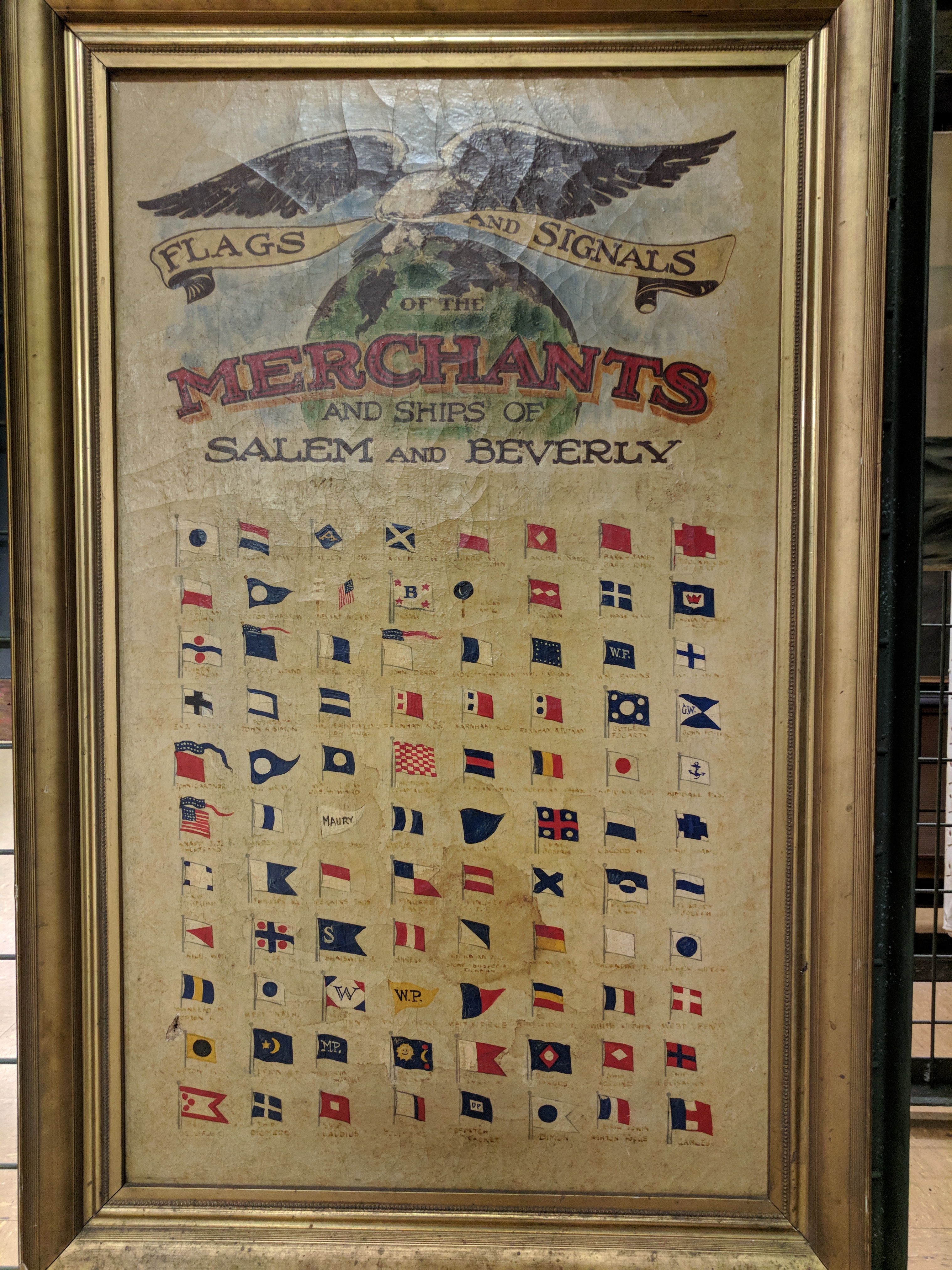
SHORT DESCRIPTION: Oil painting depicting an eagle holding a banner in its beak and sitting on top of a globe, all above the title and eighty-eight individual flags. Handwritten identifications underneath each flag. NOTES: There is an illegible sentence written below the title and above the flags. Conservation took IR and flouresence photographs and were unable to discern what it said. In the process, they found a signature on the back of the stretcher that said R._. White A 31 NOTES: James and John Barr are the two oldest sons of Captain James Barr (1721-1803). James was born August 29, 1754 and worked as a mariner, married Eunice Carlton in 1779, and he died January 19, 1848. John Barr was also a captain, mariner, and merchant; married Sarah Pierce in 1784, he died April 3, 1832. From “The Essex Antiquarian” Vol. VI, No.4, Page 156, Oct. 1902. From Hartford Courant, 19 March 1792 James Barr owned a brig named Eunice. Doctor Barstow is Dr. Gideon Barstow, born in 1783. He was a physician, merchant, then politician who served in the U.S. House of Representatives and the Massachusetts state legislature before he died in 1852. See “History of Essex County, Massachusetts,” page 2111. Jacob Crowninshield was a member of the wealthy and prominent Crowninshield family in Salem. George Crowninshield started the shipping firm in 1790 to rival the Derby shipping firm (George's in-laws), then passed it along to his sons. George's second oldest son, Jacob (1770-1808), sailed on Crowninshield and Derby vessels before entering politics in 1799. One of George's grandsons, also Jacob (1801-1857) worked in the company offices handling insurance and spoliation claims. Pickering Dodge lived from 1778-1833, son of Israel and Elizabeth. He owned numerous ships including Bengal, Gentoo, Izette, Mandarin, Midas, and Rome; brigs Ganges, Governor Endicott, and Herald; and schooner Mary Jane. His oldest son was also named Pickering though he appears to not have followed his father’s footsteps and published books on art and sculpture. Endicott & Andrews was Samuel Endicott and John H. Andrews. William Fabens (1759-1828) was a grocer nicknamed King Fabens with a shop on High Street. He had a son named William (1782-1834) and another named Benjamin born in 1785. The brothers began a shipping company in 1816, but one of the William Fabens owned ships as early as 1809 (a schooner, Neutrality, built in 1804 and registered in 1809 with William Fabens as owner and Benjamin Fabens as master). From “Some of the Descendants of Jonathan Fabens of Marblehead” page 8, 1881 by George A. Perkins and also "Ship Registers of the District of Salem and Beverly, Massachusetts, 1789-1900" Butler Fogarty was an Irish school teacher before he came to America to work in a bank. He entered the shipping industry and came to be a partial owner of numerous ships (schooners Enterprise, Fair Trader, and Viper). He worked with William Gray and died in 1816. From Essex Institute Historical Collections, page 270. John Gardner (1771-1847) was a merchant and master mariner, had wholesale import business later. Owned ship Hazard that the British sloop of war Sylph captured in 1813, only to be recaptured by American privateer Montgomery. Company was ruined by War of 1812 but started another in 1818 with son John (1796-1870) who owned ships Commerce and Ceres, and brig Osgood. The 1796 John worked with his father from 1818-1828 as captain of Ceres and Commerce. William Rufus Gray (1750-1825) started his own business at age 28. He owned privateers during the Revolution, eventually owned 15 ships, 7 barks, 13 brigs, and 1 schooner. Gamaliel Hodges (1766-1850), his father was a sea captain, and he became master of Argonaut, Eliza, Neptune, Polly and Betsey. From 1798-1804 he partnered with Ichabod Nichols and Benjamin Hodges and owned ship Active. In 1806 he partnered with Jonathan Neal with schooner Jason and brig Edwin. J.J. Knapp is Joseph Jenkins Knapp, born about 1773. His sons, Joe (Joseph Jenkins Knapp Jr.) and Frank were hung in 1830 for their part in the murder of Captain Joseph White. Joe was married to White's grand-niece and hired two Crowninshield brothers to commit the murder. William Orne (1751/2-1815) son of Jonathan and Elizabeth, worked on privateers in Revolution, owned five ships by 1789 and 30 more later. Nephew Joseph Orne was onboard Essex in 1806 when all but cabin boy murdered by Arab pirates. Owned Orne’s Wharf. Josiah Orne (1768-1825) was a son of Josiah Orne. The 1768 Josiah worked in his father’s shipping business as an agent by 1785. He owned ship Sukey and brig Issac. He owned a few ships but was never very successful but ended up working as master of ships for other owners. Samuel Page appears as a co-owner with Endicott & Andrews. He was master of ship Diomede and Jeremiah Page is listed as a co-owner in 1815. See “Ship Registers of the District of Salem and Beverly, Massachusetts, 1789-1900” page 41. David Pingree and T.P. Pingree were father and son, Thomas Perkins was David Pingree’s uncle and the namesake of his son. David was born in 1795, Thomas Perkins Pingree was born in 1830-1876 (Peabody Essex Museum finding aid) Benjamin Pickman (1763-1843) traded with India, China, East and West Indies, and Europe. His father was also Benjamin Pickman (1740-1819), whose father Benjamin Pickman (1707/8-1773) owned a successful shipping company. The 1740 Benjamin joined his father’s company after graduating from Yale and Harvard in 1759. The 1763 Benjamin worked with his brother, William, as an agent for Elias Hasket Derby and John Derby from 1790-1796. “Between 1789 and 1822, he was the sole or partial owner of thirty-three mercantile vessels…” and partial owner of whaling ships Bengal and Catherine. Stone, Silsbee, & Pickman formed in 1798 by Nathaniel Silsbee (1773-1850) Robert Stone, and Dudley Leavitt Pickman (1779-1846) to purchase ships and sell imported goods. Became Silsbee & Pickman in 1860 when brothers Benjamin W. Stone and William Stone left the company, then Silsbee, Pickman, & Allen in 1863 when George Henry Allen became a partner. Dissolved in 1898. Israel Thorndike born in Beverly April 30, 1755. Partnered with Moses Brown (Brown & Thorndike) in 1772 for 20 years. Earned small fortune as a privateer in American Revolution. Entered China trade in 1790s and earned a larger fortune. Invested with Francis Cabot Lowell in Boston Manufacturing Company, became even wealthier in textile business as president of company from 1817-1831. Died 1832. Wait & Pierce, partnership of Aaron Wait and Jerathmael Pierce traded coffee, pepper, indigo from the East Indies. By 1798 were among the largest of a group of subscribers who loaned money to government to create a navy to protect American commerce. Madeira Packet was a 114 ton schooner, registered April 20, 1819 with Emery Johnson as owner and master. From page 111 of “Ship Registers of the District of Salem and Beverly, Massachusetts, 1789-1900” published 1906. Two brigs named America are listed in “Ship Registers of the District of Salem and Beverly, Massachusetts, 1789-1900” page 8. The first was 157 tons built in Newbury in 1801, registered April 6, 1821 with Daniel Abbott as owner and Josiah Dewing as master, she wrecked on her way to Key West in 1824. The Crowninshield family papers finding aid from Peabody Essex Museum state that ship America had an 1801 voyage for pepper from Sumatra. The Crowninshields owned the ship that’s represented by the flag on this painting. Brig Argus was 125 tons built in Barnstable in 1800, registered Nov. 2, 1803. John Dutch and Thorndike Deland were owners with David Tucker as master. Registered May 2, 1804 with John Dutch Jr. and Thorndike Deland as owners and David Tucker as master. Registered Sept. 30, 1807 with Benjamin Chapman and Henry King as owners, and Benjamin Chapman as master. Registered August 8, 1808 with Benjamin Chapman as owner and master. Registered July 31, 1809 with Benjamin Ropes and Timothy Wellman, Jr. as owners and Benjamin Chapman as master. More registrations and names until sold to Portsmouth owner in December 1818. From “Ship Registers of the District of Salem and Beverly, Massachusetts, 1789-1900” The ship Belisarius launched in October, 1794 from shipyard of Enos Briggs at Stage Point, South Fields. 209 tons, enlarged to 261.5 tons 94.5 feet long, 25 feet beam, carried valuable cargoes. One of the early copper sheathed ships and launched with masts standing. First voyage ended July 26, 1795 with cargo of tea, coffee, and indigo. July 6, 1809 she left Salem headed for Lisbon but went ashore in Bay of Tunis and wrecked, though they were able to save the crew and cargo. From The Boston Globe, January 7, 1917, page 64. Owned by Crowninshield family from at least 1797-1798, from ship log in collection of Peabody Essex Museum. Ship Diomede: there are two Diomedes from the early 1800s and the Crowninshield family. The Peabody Essex Museum finding aid for the Crowninshield family papers references paperwork relating to the construction of the brig Diomede between 1809-1810; it also refers to paperwork of the construction of the privateer schooner Diomede and the prizes it captured during the War of 1812 but do not provide dates. -The British book "The Naval Chronicle for 1813," volume 30, page 252 states “American brig Diomede, of 2 guns, 232 tons, and 8 men, laden with sugar and indigo from Manila, bound to Salem, captured by the La Hogue, May 11, 1813; sent to Halifax.” -In "John Crowninshield and the Building of the Privateer Diomede" (Proceedings of the American Antiquarian Society, October 1943, pages 163-218) Howard Corning writes that Retire Beckett of Salem built the Diomede for John Crowninshield in the summer of 1809. She was captured by the British after three trips. There is no date given for the capture, but Corning states that it was important for the Crowninshields to rebuild quickly and then quotes letters regarding construction of the new Diomede dated 1813. The new Diomede launched November 8, 1813 and went on to capture quite a few British ships before the British caught her in May 1814.

 P0003-01 - E-14673
 P0003-01 - J-11420
 P0003-01 - L-5102
 My Old Man cover
 MS0164-002-05-009-39.14
 1995 47 04
 Full-size image
 lp2061
 q162
 na12_1
 QO 1027